The Future of 6G: Beyond Speed and Bandwidth
by Milad Natanzi

When we talk about the evolution from 5G to 6G, the industry narrative often focuses entirely on numbers: higher terahertz frequencies, greater spectrum bandwidth, and lower microsecond latencies. However, the true paradigm shift of 6G lies not just in raw speed, but in cognitive autonomy.
The Limits of Deterministic Networks
Current telecommunication infrastructures, including early 5G standalone (SA) architectures, are heavily deterministic. They rely on pre-calculated models, static thresholds for handover, and rigid OSI layer boundaries. With the exponential growth of connected devices—ranging from smart city sensors to autonomous vehicles—this rigidity becomes a severe bottleneck.
When a network relies on manual optimization or slow heuristic loops, it cannot react fast enough to micro-fluctuations in urban traffic interference.
Machine Learning at the Physical Layer (PHY)
In my recent research utilizing the O-RAN (Open Radio Access Network) architecture, we are exploring the integration of Machine Learning (ML) directly into the Physical Layer.
Traditionally, ML in telecom is applied at higher layers (e.g., predicting user churn or allocating macro-resources in the core network). But by embedding neural networks into the baseband processing units (BBUs), we can enable the network to “learn” the optimal modulation schemes and beamforming patterns on the fly.
Here are the key benefits:
- Local Context Memory: Base stations shouldn’t just react; they should remember. By utilizing temporal models (like LSTMs or Transformers), a cell tower can learn daily interference patterns from a nearby factory and proactively adjust its transmission strategy before interference actually peaks.
- Resilience over Raw Speed: In critical applications like robotic surgery or V2X (Vehicle-to-Everything) communication, dropping a packet is far worse than delivering it slightly slower. ML-driven PHY layers prioritize connection stability anchors over maximum throughput when the environment gets noisy.
“The jump to 6G is less about making the pipes bigger, and more about making the pipes intelligent enough to fix their own leaks.”
Toward a Distributed Intelligence Mesh
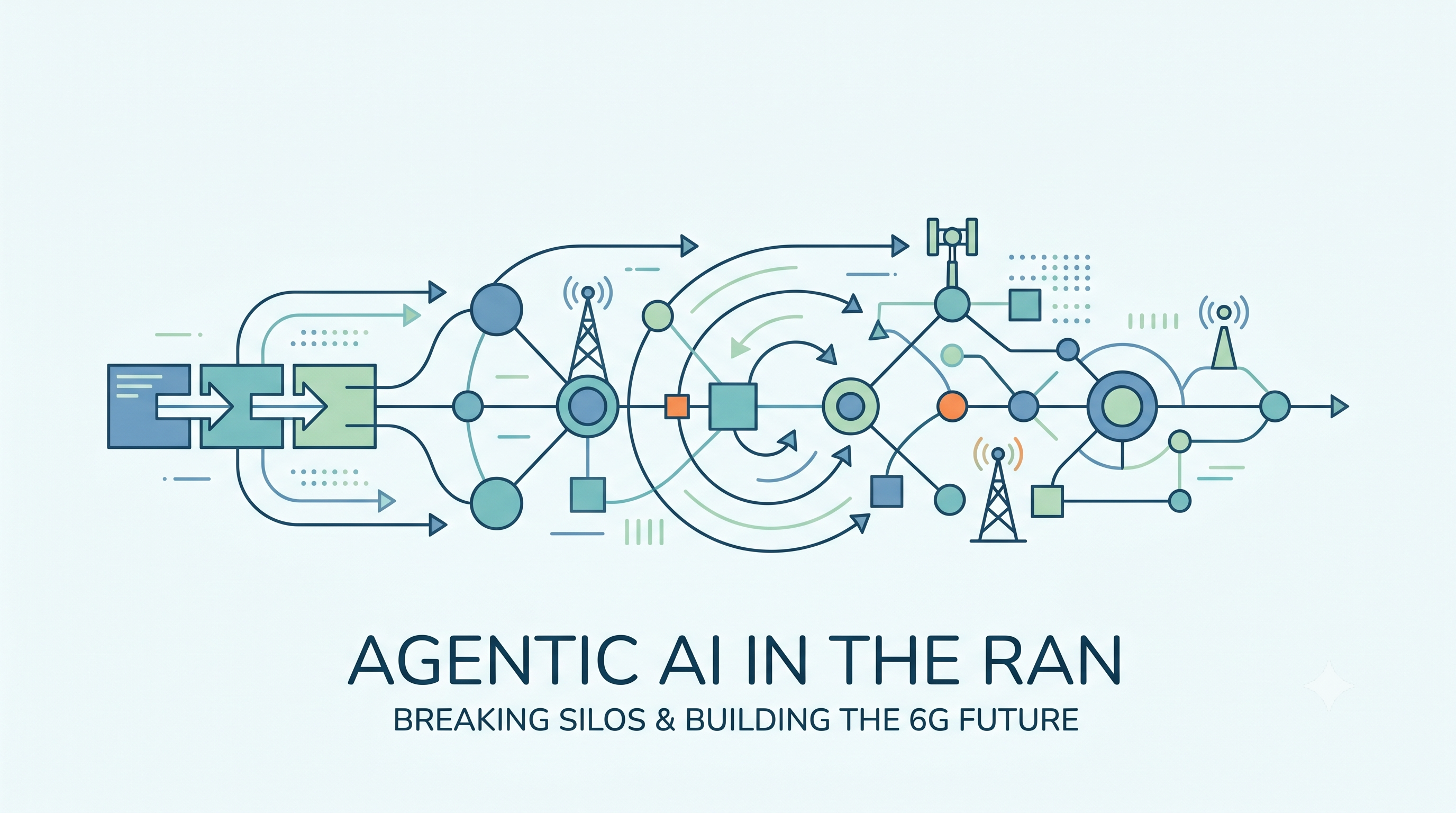
The shift to 6G brings us closer to a fully decentralized intelligent mesh. Instead of a centralized cloud orchestrator dictating rules to “dumb” towers, each node in the 6G network will act as an autonomous agent.
By employing Federated Learning, these nodes can share optimization insights with neighboring towers without transmitting raw user data. If a cell tower in Downtown Boston learns a new way to mitigate millimeter-wave scattering during heavy rain, it can instantly share that “knowledge model” with a tower in Seattle experiencing similar weather.
The work we have ahead is incredibly challenging—managing computational overhead on edge devices and ensuring AI models don’t collapse in edge cases—but it is the only viable path to a resilient, ubiquitous 6G future.